Kingwood Underground
the heart and soul of our Kingwood, Texas family
Login - Create Account - Help
Clean out your garage on Kingwood bookoo! Or find local garage sales on Yard Sale Search.com
KU Live!

*** Abandoning nuclear facility***

who's talking here?

hummer 1
rEVOLution 9
Hiro Protagonist 1
anti-antichange 3
voice of reason 10
Tipsyhic 1
Aah Grasshoppa 2
LiveFreeOrDie 1
Clovis 6
Dorothy Parker 1
Circlesmile 1

     » send to friend     » save in my favorites     » flag dangerous topic flag as a dangerous topic

rEVOLution --- 15 years ago -

I can't verify this yet but this is what I'm hearing.

workers are abandoning the plant. There is nothing they can do as we are in "sarcophag­us" phase but there are not the materials and the where-with­-all present at the plant to do it at this time. There is nothing preventing the complete destructio­n of 4 reactors (bad) and their 4 spent fuel ponds 

Circlesmile --- 15 years ago -

Well this is serious I hope they dont panic people. If they are abandoning then all is lost and devastation is inevitable. 

rEVOLution --- 15 years ago -

If they are abandoning then all is lost and devastation is inevitable.

That's pretty much the way it's looking right now.

And this is not the only facility they are struggling with. 

rEVOLution --- 15 years ago -

From CNN...

Workers at Japan's damaged nuclear power plant have suspended operations and evacuated, chief Cabinet secretary says. 

anti-antichange --- 15 years ago -

circlefrown. :( 

Dorothy Parker --- 15 years ago -

:(

Where are they going to go? How do you escape something like that on an Island?? :( 

rEVOLution --- 15 years ago -

The media is not getting any answers either. Their nuclear experts are like "I hope we are misinterpreting what their saying" It's not making any sense right now. 

Aah Grasshoppa --- 15 years ago -

This ain't gonna end well. And the prevailing winds push the radiation towards the US west coast. 

hummer --- 15 years ago -

We will get advisories most likely to stay inside due to radiation fallout.
This is a global disaster.
I hope I'm wrong but this have consequences for many years. 

anti-antichange --- 15 years ago -

We will get advisories


no we wont/ 

Tipsyhic --- 15 years ago -

We will get advisories
Bend over and kiss your Arses goodbye.LOL 

Clovis --- 15 years ago -

Radiation monitoring in the U.S. Hit refresh to update:

http://www.radiationnetwork.com/ 

anti-antichange --- 15 years ago -

thr fire reignitd. :( 

Aah Grasshoppa --- 15 years ago -

I think TEPCO has no idea what to do and this will be a disaster of epic proportions. Weather predictions are saying the winds will shift from the southeast by the weekend, sending the radiation particles back over the country of Japan. God be with them. 

rEVOLution --- 15 years ago -

Nowhere in this report is there anything stating what's next...

FUKUSHIMA, Japan (AP) -- Japan suspended operations to prevent a stricken nuclear plant from melting down Wednesday after a surge in radiation made it too dangerous for workers to remain at the facility.

Chief Cabinet Secretary Yukio Edano said work on dousing reactors with water was disrupted by the need to withdraw.

The level of radiation at the plant surged to 1,000 millisieverts early Wednesday before coming down to 800-600 millisieverts. Still, that was far more than the average

"So the workers cannot carry out even minimal work at the plant now," Edano said. "Because of the radiation risk, we are on standby."

Experts say exposure of around 1,000 millisieverts is enough to cause radiation sickness.

Earlier officials said 70 percent of fuel rods at one of the six reactors at the plant were significantly damaged in the aftermath of Friday's calamitous earthquake and tsunami.

News reports said 33 percent of fuel rods were also damaged at another reactor. Officials had said they would use helicopters and fire trucks to spray water in a desperate effort to prevent further radiation leaks and to cool down the reactors.

The nuclear crisis has triggered international alarm and partly overshadowed the human tragedy caused by Friday's double disaster, which pulverized Japan's northeastern coastline, killing an estimated 10,000 people.

Authorities have tried frantically since the earthquake and tsunami to avert an environmental catastrophe at the Fukushima Dai-ichi complex in northeastern Japan, 170 miles (270 kilometers) north Tokyo.

The government has ordered some 140,000 people in the vicinity to stay indoors. A little radiation was also detected in Tokyo, 150 miles (240 kilometers) to the south and triggered panic buying of food and water.

There are six reactors at the plant, and three that were operating at the time have been rocked by explosions. The one still on fire was offline at the time of the magnitude 9.0 quake, Japan's most powerful on record.

The Nuclear and Industrial Safety Agency estimated that 70 percent of the rods have been damaged at the No. 1 reactor.

Japan's national news agency, Kyodo, said that 33 percent of the fuel rods at the No. 2 reactor were damaged and that the cores of both reactors were believed to have partially melted.

"We don't know the nature of the damage," said Minoru Ohgoda, spokesman for the country's nuclear safety agency. "It could be either melting, or there might be some holes in them."

Meanwhile, the outer housing of the containment vessel at the No. 4 unit erupted in flames early Wednesday, said Hajimi Motujuku, a spokesman for the plant's operator, Tokyo Electric Power Co.

Japan's nuclear safety agency said fire and smoke could no longer be seen at Unit 4, but that it was unable to confirm that the blaze had been put out.

Yuasa reported from Tokyo. Associated Press writers Elaine Kurtenbach in Tokyo and David Stringer in Ofunato contributed to this report. 

rEVOLution --- 15 years ago -


Clovis --- 15 years ago -

Meanwhile, the outer housing of the containment vessel at the No. 4 unit erupted in flames early Wednesday

Close-up photo of No. 4:

0 

Hiro Protagonist --- 15 years ago -

Close-up photo of No. 4:


Looks good! That shouldn't have any problem containing radiation. 

rEVOLution --- 15 years ago -

Have you noticed the photos of this facility. They keep saying that the backup generators failed because it was hit by the tsunami but there is absolutely no evidence that this plant or surrounding areas were hit by the tsunami.

From what I see on maps the tsunami was further southwest of the plant.

Regardless, it happened and it's not looking bad. I just read also that there is a huge hole in the ozone above this plant. 

Clovis --- 15 years ago -

They keep saying that the backup generators failed because it was hit by the tsunami but there is absolutely no evidence that this plant or surrounding areas were hit by the tsunami.

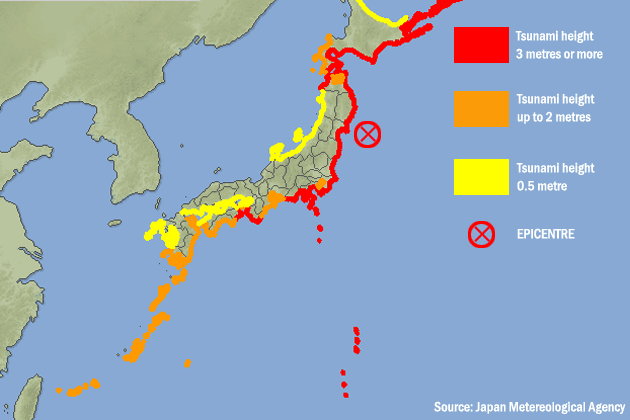
I think that it was. Check out this map of the damage:

0

I don't think they could have avoided it. I believe the sea walls helped to decrease damage. I've heard that the back-up generators sat lower on the ground and received flood damage. If I run across a picture, I'll post it. 

rEVOLution --- 15 years ago -

Yeah I don't see how they could have avoided it being right on the coast but if you see the photos of the first explosion, there's minimal if any damage around the plant.

Other than the damage from the explosion, I just don't see signs of extremely high water. No debris in trees, cars in the parking lots, on buildings damaged.

I could be wrong, just going with what I can see. But then I see other images that look like it was hit, so I don't know. All I know is things are really bad there.

0 

voice of reason --- 15 years ago -

They keep saying that the backup generators failed because it was hit by the tsunami but there is absolutely no evidence that this plant or surrounding areas were hit by the tsunami.


from pictures i saw the plant was right on the ocean so it had to be hit. this is not a conspiracy by man. god did it. 

voice of reason --- 15 years ago -

Yeah I don't see how they could have avoided it being right on the coast but if you see the photos of the first explosion, there's minimal if any damage around the plant.

Other than the damage from the explosion, I just don't see signs of extremely high water. No debris in trees, cars in the parking lots, on buildings damaged.

I could be wrong, just going with what I can see. But then I see other images that look like it was hit, so I don't know. All I know is things are really bad there.


bad and sad. maybe all the pics aren't exactly what you think they are. are they all from mainstream media sources or from conspiracy sites? 

voice of reason --- 15 years ago -

rev was just reading about this and the comment tells us contrary to what you were thinnking earlier;

Workers were trying to clear debris to build a road so fire trucks could reach reactor No. 4 at the Daiichi complex in Fukushima, 240 km (150 miles) north of Tokyo. Flames were no longer visible at the building housing the reactor. 

Clovis --- 15 years ago -

Here's a photo showing the sea walls I was talking about. This is what I believe helped to "save" the site from the worst part of the tsunami:

0 

voice of reason --- 15 years ago -

good thing it had the sea walls but they seem like nothing compared to a 30 meter tsunami. then again things didn't wash out like rev pointed out happened elsewhere. 

Clovis --- 15 years ago -

good thing it had the sea walls but they seem like nothing compared to a 30 meter tsunami. then again things didn't wash out like rev pointed out happened elsewhere.

If you look at the damage map I posted above, it shows the plants received 3 meters or more. The wave wasn't 30ft. for all locations. rEV does ask a good question though.

What doesn't make sense to me is that the back-up generators where placed on a lower level than the plants. Lots of questions still to be answered. 

voice of reason --- 15 years ago -

i did look at the map but am unfamiliar with location of the nuke plant. 

Clovis --- 15 years ago -

Finally, I found before and after pictures. I'd post them, but they are in a PDF file. Page 3 shows the plants before the earthquake/tsunami. On page 4, it shows a picture (with 2 insert pics) showing "Significant Damage to Surface
Structure/Water Intake Screens."

If someone could post them, that would be great. My computer skills are only elementary at best : )

http://www.digitalglobe.com/downloads/DG_Analysis_Japan_Daiichi_Reactor_March2011.pdf 

rEVOLution --- 15 years ago -

Those photos showed mostly the damage from the explosions. If the tsunami had hit there, would the cars, trucks, and portable storage units all be inland like all the other cities south of there where ships were washing up on shore? Also the water around the plant is spotless and free of any debris from the tsunami. Look how clean everything is around the firefighting ships in the photo above.

I don't know anymore. Things coming from out of Japan just aren't adding up. I do agree on one thing, that they and possibly the world are in for some trouble if they don't contain these things. This also is not the only plant in trouble right now. 

voice of reason --- 15 years ago -

so you think all the pictures are from before the earthquake? where's your head at man? 

voice of reason --- 15 years ago -

http://graphics8.nytimes.com/images/global/backgrounds/transparentBG.gifhttp://graphics8.nytimes.com/images/global/backgrounds/transparentBG.gif
cant post the pic since it is a gif.

from n.y.times right now.
March 16, 2011
U.S. Calls Radiation ‘Extremely High’ and Urges Deeper Caution in Japan
By DAVID E. SANGER and MATTHEW L. WALD
WASHINGTON — The chairman of the United States Nuclear Regulatory

(removed article and posted link below since it was too hard to read due to large pic in posts above this one) 

voice of reason --- 15 years ago -

hard to read because of large photo above but it says cooling systems were damaged.

full story with other images, multimedia, etcetera 

voice of reason --- 15 years ago -

Have you noticed the photos of this facility. They keep saying that the backup generators failed because it was hit by the tsunami but there is absolutely no evidence that this plant or surrounding areas were hit by the tsunami.


not what i read.
multimedia that explains exactly how it all works and what happened / is happening.
i think it said it all began from lack of electricity to run it which is ironic since it generates electricity. 

voice of reason --- 15 years ago -

Top U.S. nuclear regulatory official says no water remains in a pool used to cool spent fuel at Japan’s earthquake-damaged Fukushima Daiichi nuclear plant

^^^
sounds like recipe for complete meltdown 

LiveFreeOrDie --- 15 years ago -

When the earthquake hit, the reactors were automatically shut down (ie control rods inserted), which stopped the nuclear (fission) reactions. As the article indicates, stopping the nuclear reactions does not instantly eliminate the heat. Think of it like your car: you just drove it for 4 hours, stopped and turned it off. The engine is no longer running, however, the engine, radiator, exhaust, etc are still extremely hot. Unlike your car, which cools down solely by heat exchange with the air after it's turned off, a nuclear reactor still requires water to be circulated to cool it down. This is because of the normal heat level. A car engine is typically kept about 195 degrees F (water boils at 212 degrees F). Depending on the type reactor (boiling water or pressurized water), a nuclear reactor runs at temperatures of about 550 degrees F to 700 degrees F when water is present (pressure is used to increase the boiling temperature of water).

After the earthquake, everything was fine at the plants until the tsunami hit and knocked out all the electrical power including the emergency diesel generators the plants were running on. Since the pumps that keep the water circulating to remove residual heat run on electricity, they shut down. When that happened, the residual heat was enough to turn the water into steam. As more water turns to steam, the water level drops, and with no pumps to add more water, eventually the fuel rods are uncovered and exposed to air. The fuel rods are still so hot that uncovering them results in a significant increase in temperature (think of your car engine with little water in the radiator). The fuel rods can become so hot (approximately 4000 degrees F) that the outer casings begin to melt and you have 'meltdown'.

The hydrogen problem is related as a byproduct of the overheating problem. When the core overheats due to loss of coolant, the temperature gets high enough (700 to 1000 degrees F) to break water down into its individual elements (hydrogen and oxygen). Since there is twice as many hydrogen atoms as oxygen (H2O), the buildup of hydrogen occurs at a faster rate than the buildup of oxygen and hydrogen is an explosive gas. The hydrogen forms an explosive bubble inside the reactor vessel, which can result in an explosion, since you also have heat and oxygen present, so there are provisions to bleed the hydrogen out of the reactor vessel and into the building that houses the reactor vessel. Normally, the bleed off is at a slow rate and doesn't pose a problem, however as the temperature increases, the bleed off rate accelerates. Similar to a house with a small gas leak, eventually there is enough buildup of gas that a heat source causes an explosion. Once the explosion occurs, any further release of hydrogen will be dissipated by the air (just like a natural gas leak with the windows and doors open.) Nuclear plants don't have the ability to open windows and doors, since normally the air is filtered and monitored before any is released, so they were walking a fine line. Bleed off too much hydrogen too fast and cause an explosion in the building or don't bleed it off enough fast enough and cause a worse meltdown or explosion in the reactor. Like a tightrope walker, they lost their balance in two of the units and explosions occurred.

Additional units may experience explosions; however, that's not necessarily a bad thing under the circumstances. The more important thing is to keep the reactor vessels intact to minimize the amount of radiation released. If they have to sacrifice more buildings to keep the reactor vessels intact, they will. After the explosions, there is a measurable amount of radiation released as more hydrogen is bleed from the reactor, although the amount is minimal compared to the alternative. As a precaution they evacuated the area near the plants and monitor the radiation release. No cover-up or conspiracy.
 

page 1
Login to add your comments!

see more discussions about...


Online now:
hit counters

Terms of Service - Privacy Policy - Ice Box

Kingwood Underground